
Arthrosamid vs PRP for Knee Osteoarthritis: How to Choose
How Arthrosamid and PRP compare for knee osteoarthritis: mechanism, evidence, cost, and who each one suits.

Platelet-Rich Plasma (PRP) is a concentrated form of your own platelets—the cells responsible for repair, regeneration, and tissue recovery. After drawing a small amount of blood, we spin it in a medical centrifuge to isolate the platelet-rich layer.
This concentrated PRP is then injected into the injured or thinning area, where it:
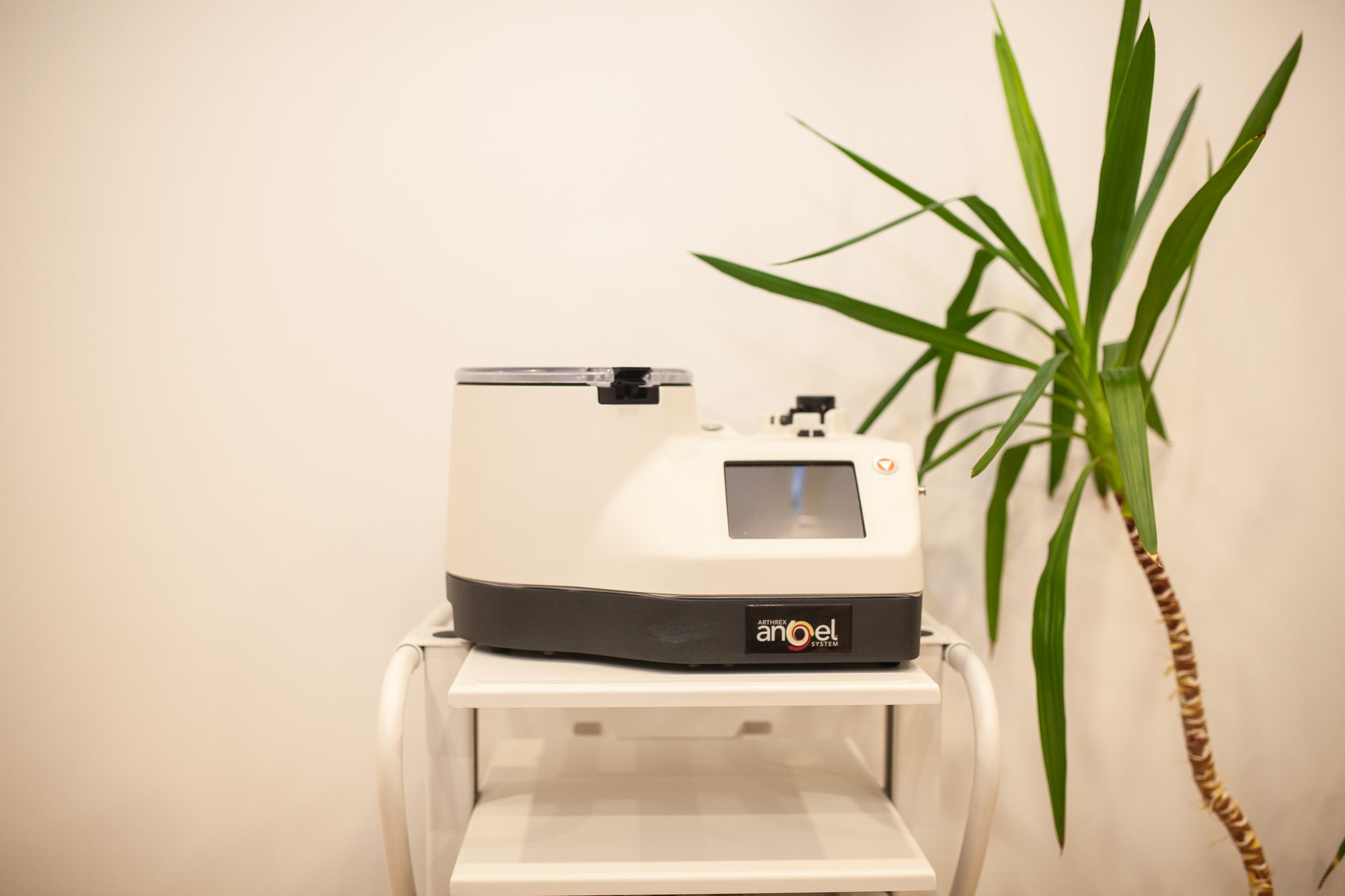
Our PRP treatments in Toronto and Oakville use high-quality medical centrifuge systems such as the AngelⓇ cPRP system by Arthrex for high platelet concentration and predictable clinical results.
PRP therapy offers powerful, natural benefits for injury recovery, joint pain, and long-term tissue health:
PRP is ideal for patients seeking a non-surgical treatment that accelerates healing and improves long-term outcomes.
Most patients notice improvement over 4–12 weeks as tissue remodelling progresses. Not sure whether your condition is a fit? Book a discovery call and our physicians will give you an honest assessment of whether PRP is appropriate for you.
Many patients come to us after cortisone has stopped working — or while weighing several injection options for the same joint. Each does something different, and the right choice depends on your tissue, your imaging, and your goals.
A steroid anti-inflammatory. Relief can be fast, but it typically wears off over weeks to months, and repeated use may weaken tendon and cartilage over time. Best suited to short-term control of a painful flare.
A lubricating gel injection (viscosupplementation) that cushions the joint. Comfort typically lasts up to six months — it eases friction, but does not repair damaged tissue. Often used for mild to moderate knee osteoarthritis.
A long-lasting hydrogel injected into the knee for osteoarthritis. A single treatment can provide durable symptom relief, though it does not regenerate tissue. We offer Arthrosamid when knee OA no longer responds to other injections.
Concentrated platelets from your own blood, placed precisely into the injured structure under ultrasound guidance to stimulate your body's repair process. Improvement builds over 4–12 weeks and tends to last longer — the only option here aimed at healing the underlying tissue rather than masking symptoms.
We offer all of these injection therapies in-clinic, alongside prolotherapy and prolozone. Your physician will tell you honestly which — if any — is right for your joint.
PRP is also used outside the joints. Our physicians offer it for men's sexual health as the P-Shot, for erectile dysfunction and Peyronie's disease, and for women as the O-Shot.

A PRP injection starts a healing cascade — but how well your body finishes the job depends on the raw materials and cellular conditions it has to work with. Cellular medicine is the core of our practice, and it's what sets our PRP program apart: we know how to support the biology of repair so you get the most out of every session. Depending on your injury, your physician may pair your PRP with:
A recovery-focused vitamin and amino acid infusion — vitamin C, magnesium, calcium, potassium, taurine, proline, lysine, L-carnitine, B-100 complex, methyl-B12, pyridoxine, dexpanthenol, MSM, zinc and trace elements. These are the building blocks collagen synthesis runs on. Learn more
Our intensive connective tissue rebuild infusion, designed to feed the ligament, tendon and cartilage repair your PRP has set in motion. Learn more
Collagen cannot be built without vitamin C. High-dose IV administration reaches tissue concentrations that oral supplements cannot, supporting the collagen production phase of your recovery. Learn more
Photobiomodulation supports circulation and cellular energy production in healing tissue — a gentle, non-invasive complement in the weeks after your injection. Learn more
Transdermal ozone with CO2 and heat to support circulation, oxygenation and recovery — one of the pairings our PRP patients use most often. Learn more
Using the MCT device, we can augment your PRP with exosome- and stem-cell-rich fractions derived from your own blood plasma — an option for stubborn, chronic injuries. Available as an add-on to any PRP treatment (see pricing below).
We don't do all of this at once — and you don't need to. Your clinical team recommends the pairing, if any, that's right for your injury, your biology and your goals.
Regenerative injection therapy is a core focus of our medical practice. Our PRP program is built on:
Patients choose us because we combine medical expertise with a deeply compassionate, personalized approach.



Hear directly from one of our patients about their experience with PRP treatment at Upper Room Clinic.
Shared with the patient's consent. Individual results vary and no outcome is guaranteed.
Transparent pricing — no surprises at the clinic. Every treatment is performed by a physician and includes ultrasound guidance where appropriate.
$950
2–5× baseline platelet concentration. Well suited to smaller joints and mild to moderate tendon injuries.
$1,400
Up to 18× baseline platelets, prepared on the Angel® cPRP system. Recommended for knee osteoarthritis, larger joints, and stubborn chronic injuries.
+$250
Optional add-on for enhanced comfort and treatment efficacy.
$175
Physician assessment of your injury and candidacy. Fee waived when you book your treatment within 7 days.
PRP injections are not covered by OHIP. We provide detailed receipts for extended health plans and Health Spending Accounts. Chronic pain consultations can be OHIP-covered — complete our self-referral form to get started. Prices are subject to change.
At Upper Room Clinic, standard PRP is $950 per treatment (2–5× baseline platelet concentration) and high-concentration PRP is $1,400 (up to 18× baseline, prepared on the Angel® cPRP system). An injection therapy consultation is $175, and the fee is waived when you book your treatment within 7 days.
PRP injections themselves are not covered by OHIP. Depending on your plan, some extended health benefits or Health Spending Accounts may reimburse part of the cost — we provide detailed receipts you can submit. Chronic pain consultations with our physicians can be OHIP-covered with a referral or self-referral.
No. You can book a consultation directly — no physician referral is required for PRP treatment.
We're honest about this: because our PRP is prepared at very high platelet concentrations — especially our Angel® Arthrex-derived PRP — the injected area is quite uncomfortable for the first week, and you won't be able to use it at all during that time. It gets better in the second week, but we still recommend keeping the area immobilized until two weeks post-injection. Over the following two weeks you can begin gently using the area again. Don't book any physiotherapy appointments until at least four weeks after your injection.
Many patients need only a single treatment. More severe or long-standing conditions — such as advanced knee osteoarthritis or chronic tendinopathy — may benefit from 2–3 injections spaced several weeks apart. Your physician will give you a clear recommendation at your consultation.
Cortisone is an anti-inflammatory: it can relieve pain quickly, but the effect wears off and repeated use may weaken tendon and cartilage tissue over time. PRP works differently — it delivers concentrated growth factors that stimulate your body's own repair process, so improvement builds gradually and tends to last longer.
It depends on the concentration. With our lower-concentration PRP injections, benefits are typically felt at around 4 weeks. With high-concentration PRP (up to 18× baseline platelets), the repair process runs deeper and benefits take anywhere between 6–8 weeks to be felt, with continued gains in the months that follow.
Plan for the injected area to be fully immobilized for the first two weeks — crutches, walking boots and arm slings are available for purchase at the clinic if you don't have your own. Desk work is usually fine early on if it doesn't involve the injected area. Gentle use resumes from weeks two to four, physiotherapy from four weeks onward, and sport is reintroduced gradually with your physician's plan.
Because PRP is made from your own blood, the risk of allergic reaction or rejection is very low. As with any injection there is a small risk of infection, bleeding, or temporary pain flare. All injections at Upper Room Clinic are performed by physicians using sterile technique and ultrasound guidance for precise placement.
PRP may not be appropriate if you have an active infection, certain blood or platelet disorders, an active cancer, or if you are on medications that significantly affect platelet function. Some conditions also respond better to other treatments — which is why every PRP plan at our clinic starts with a physician assessment.

Selected references
Individual results vary and no outcome is guaranteed. PRP is not appropriate for every patient or every condition — a physician assessment is required to determine whether it is right for you.

Contact Us
Locations
Upper Room Clinic – Oakville
Tel: 647-521-8024 ext. 2
Fax: (289) 644-0255
oakville@upperroomclinic.com
Upper Room Clinic – Davisville
Tel: 647-521-8024
Fax: 647-348-8024
hello@upperroomclinic.com
Tuesday to Saturday
11am-6pm
Stay connected
Sign up to receive updates, offers, and the latest news directly to your inbox.
Copyright © 2026 Upper Room Clinic | Privacy Policy | Terms of Use