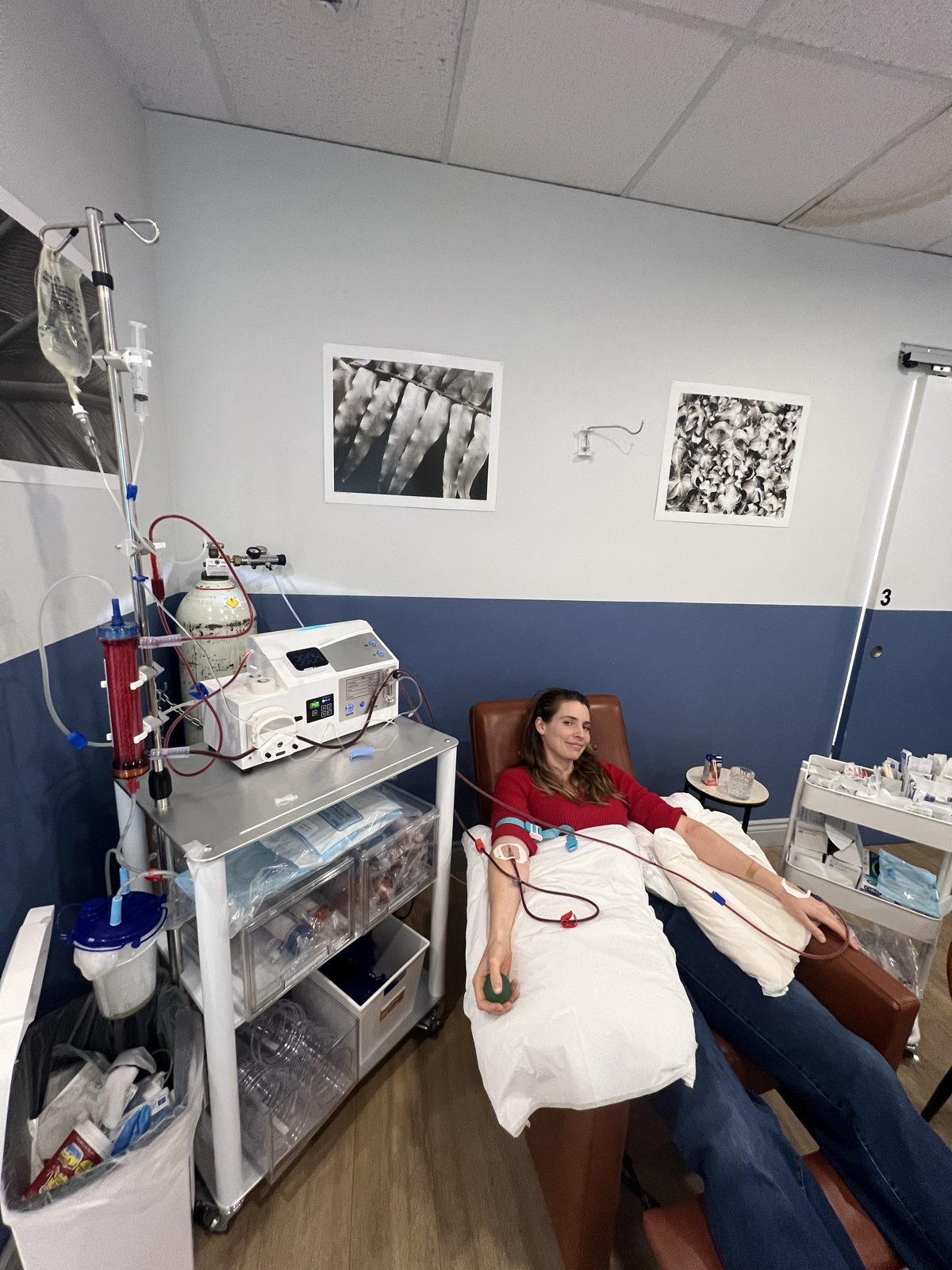
EBOO (also known as Ozone Dialysis or EBOO-F) is an advanced, filtered form of ozone therapy. Your blood is continuously circulated through a sterile, medical-grade dialysis system where three things happen at once: it is filtered across a dialysis membrane, enriched with medical ozone, and treated with ultraviolet light (ultraviolet blood irradiation, or photobiomodulation). Unlike standard ozone IV (MAH) or 10-Pass — which treat blood in batches and don't filter it — EBOO runs continuously, processing roughly two litres of blood in a single session while combining filtration, oxygenation, ozonation, and UV light in one circuit. This supports:
Because oxidized proteins, inflammatory metabolites, and circulating waste bind to the dialysis membrane and are carried off, EBOO adds a physical purification step that batch ozone therapies don't include.
EBOO vs. IV Ozone (10-Pass). Both use medical ozone, but they work differently: IV Ozone 10-Pass treats your blood in roughly ten separate batches at a higher ozone concentration, while EBOO treats it continuously at a gentler dose, adds ultraviolet light, and filters it through a dialysis membrane along the way. Many patients use them at different stages of care — your clinician can help you decide which fits your goals.
EBOO works on a simple principle with three layers. Two of them — medical ozone and ultraviolet light — are mild, controlled oxidative stimuli that briefly challenge the blood, prompting the body to switch on its own protective systems. This adaptive response is called hormesis, and it is well described for both ozone and ultraviolet blood therapy. The third layer — continuous, dialysis-grade filtration — physically clears a portion of the circulating inflammatory load at the same time.
Ozone. When ozone dissolves into blood it generates short-lived messenger molecules that activate the Nrf2/ARE antioxidant pathway, increasing the body's own protective enzymes — superoxide dismutase, catalase, and glutathione peroxidase — and shifting the immune balance away from pro-inflammatory signalling.
Ultraviolet light (UBI). The ultraviolet step is not about sterilising the blood — only a small fraction of your blood volume is in the light at any moment. Instead, UV modulates the immune cells themselves, enhancing the ability of white blood cells to engulf pathogens, improving oxygen utilisation, and rebalancing cytokine activity. No microorganism has been shown to develop resistance to UV, and any UV-related changes in your own cells are rapidly repaired. Crucially, blood is opaque — UV cannot penetrate it more than about a hair's width — so a film of blood on the quartz window will block the light unless the chamber turbulates the blood to keep fresh cells moving into the beam. Our system uses a turbulated cuvette built on Emmet Knott's original 1948 design, with a full-spectrum source (UVA, UVB, two UVC bulbs, and LED), so the light actually reaches and treats the blood.
Continuous filtration. Throughout the session your blood also passes through a medical-grade dialysis membrane, so oxidised and contaminated proteins, excess lipids, cellular debris, and inflammatory byproducts bind to the filter and are carried off into the waste rather than returned to you. Because this runs continuously — rather than adding ozone to blood that is then returned unfiltered, as batch methods do — EBOO both stimulates the body's defences and physically clears part of the circulating inflammatory load in a single treatment.


EBOO offers benefits that go beyond a standard ozone IV:
EBOO is used as part of a broader, physician-guided care plan. It's most often considered for:
EBOO is often chosen by patients who haven't fully responded to standard therapies, are managing complex chronic symptoms, or want a deeper systemic reset. Because it is a medical procedure, every candidate is assessed individually at a consultation before treatment, and it works best as one part of an integrated plan rather than a standalone drip.
Who should not have EBOO. EBOO isn't right for everyone. It is generally not recommended during pregnancy, or for people with glucose-6-phosphate dehydrogenase (G6PD) deficiency (favism), significant anemia, a bleeding or clotting disorder (including a history of heparin-induced thrombocytopenia), uncontrolled hyperthyroidism, or unstable cardiovascular disease. Your physician will review your history, medications, and bloodwork to confirm EBOO is safe and appropriate for you.
.jpg)


Yes. When performed by trained clinicians, EBOO is well tolerated and has an excellent safety profile. Blood pressure, oxygenation, and flow rates are monitored throughout.
Standard ozone (MAH or 10-Pass) treats a smaller amount of blood. EBOO continuously filters and ozonates up to 3 liters, providing a deeper detox, immune modulation, and metabolic effect.
Most patients complete 4–10 sessions, depending on severity of symptoms and health goals. Chronic infections or autoimmunity often require multi-week programs.
EBOO stands for Extracorporeal Blood Oxygenation and Ozonation. It's a full-system blood therapy, not an IV drip. During a session, blood is gently drawn from a vein in one arm, passed through a sterile filter, enriched with medical ozone across the large surface area of that filter, and exposed to ultraviolet light (a step known as ultraviolet blood irradiation, or photobiomodulation) before being returned to you through a vein in the other arm.1, 6 At the same time, the blood passes through a medical-grade dialysis filter: alongside oxygenation and ozonation, contaminated proteins, excess lipids, and inflammatory byproducts bind to the dialysis membrane and are removed, so the blood comes back both energized and purified.1 The circuit is a closed loop driven by a peristaltic pump, which moves the blood gently to protect your red blood cells, and it requires two peripheral IV lines (20 gauge or larger). The result is a continuous, real-time cleansing and recharging of your blood while you rest comfortably — combining the oxidative “training” effect of ozone, the immune-modulating effect of UV light, and continuous dialysis-grade filtration in a single treatment.1, 6
They rely on the same ozone biology but deliver it very differently. 10-pass IV ozone (major autohemotherapy, or MAH) treats blood in batches — a fixed volume is drawn off, mixed with a high concentration of ozone gas from a pressurized generator such as the Zotzmann 2000, reinfused, and the cycle repeated. EBOO instead circulates the blood continuously through a filtered oxygenation–ozonation membrane and adds ultraviolet light, processing roughly two litres in a single session. Beyond that, three distinctions matter more for how the therapy actually works and feels:
Continuous filtration. EBOO's circuit runs the blood through a medical-grade dialysis filter that the 10-pass method doesn't have at all. As the blood passes through, oxidized and contaminated proteins, lipids, and inflammatory byproducts bind to the membrane and are physically carried off into the waste — so the blood returns not only oxygen-rich but genuinely filtered.1 For the patient, that means an actual reduction in circulating inflammatory waste, on top of the ozone and light effects.
A smaller ozone dose at any one moment — so the effect is felt more subtly. Because EBOO ozonates continuously across a large volume, the concentration of ozone gas in contact with the blood at any given instant is much lower than the concentrated bolus a 10-pass machine like the Zotzmann 2000 delivers with each pass — in the EBOO research, ozone was used at just 0.5–2 µg/mL of oxygen.1 The result is a gentler, more gradual experience rather than the intense “hit” some people feel with high-concentration passes.
A longer-lasting immune activation. When ozone meets blood it produces two kinds of messenger: hydrogen peroxide, which acts immediately and is gone within minutes, and lipid ozonation products — lipid peroxides such as 4-hydroxynonenal — which are the longer-lived “late messengers” that keep circulating and signalling after the session ends.4 Because EBOO treats a large blood volume continuously, it generates a sustained rise in these lipid peroxides (a single EBOO session raises lipid-peroxidation markers several-fold),1 which is thought to keep the Nrf2 antioxidant and immune pathways switched on well after you leave the clinic. In practice that translates to a steadier, more prolonged activation of the immune and antioxidant response.3, 2
This is worth setting straight, because some marketing (notably the “EBO2 vs EBOO” material circulating) presents EBO2 as a fundamentally more powerful system. In reality, EBOO and EBO2 are the same class of extracorporeal ozone therapy: both filter the blood in a similar way through a medical-grade dialysis membrane, both add ozone over the large surface area of the filter, both run on a peristaltic pump, and both require two peripheral IV lines. The specific claims used to distinguish them don't hold up:
The one difference that genuinely matters is the ultraviolet light chamber (see the next question).
The ultraviolet part of EBOO traces back to Emmet Knott, who developed ultraviolet blood irradiation in the 1930s–40s. Knott's central discovery is the key to the whole thing: blood is opaque, and UV light cannot penetrate it more than about a hair's width. As blood flows past a quartz window, it leaves a thin film that absorbs the UV and blocks it from reaching the rest of the blood. To work, the chamber therefore has to turbulate the blood — keep it churning — so that fresh blood is constantly brought into contact with the light and all of it is exposed evenly.5, 6
The EBOO system uses a turbulated cuvette built on Knott's original design, with a full-spectrum light source (UVA, UVB, two UVC bulbs, plus LED) roughly three times the power of the original Knott device — which allows the energy dose to be quantified and applied uniformly. By contrast, a UV device without turbulation (such as the Hemealumen unit used by EBO2) lets that blood film form and block the light, so after the first pass the additional exposure accomplishes little. More wavelengths of light or a longer stretch of quartz tubing don't help if the light can't actually reach the blood. In UV blood therapy, turbulation — not tubing length — is what determines whether the light does anything.5, 6
We keep a separate Hemealumen device in the clinic that we use on the last pass of our IV Ozone Therapy only, because the training explicitly states it loses therapeutic effect after the first pass.
Not quite — and the distinction matters. EBOO genuinely filters your blood, using the same class of medical-grade dialysis membrane found in renal dialysis, so it's fair to say it borrows dialysis technology.1 But its purpose is different. Kidney dialysis exists to replace lost kidney function, removing metabolic waste and excess fluid to keep someone alive when their kidneys can't. EBOO does not replace kidney function and isn't a treatment for kidney failure. Instead, it combines that filtration with ozone and ultraviolet light to oxygenate the blood, modulate the immune system, and support cellular detoxification — filtration in service of a broader therapy, not organ replacement.
EBOO combines two mild oxidative stimuli — ozone and ultraviolet light — that work on the same principle: a brief, controlled “stress” that switches on the body's own protective systems. This is called hormesis, and it's well described for both ozone and UV blood therapy.3, 6
On the ozone side, when ozone reacts with blood it generates signalling molecules that activate the Nrf2/ARE antioxidant pathway, raising your own protective enzymes — superoxide dismutase, catalase, glutathione peroxidase — and shifting the immune balance away from pro-inflammatory signalling.3, 2
On the ultraviolet side, the goal isn't to sterilize the blood — only a small fraction of your blood volume passes through the light at once, so direct germ-killing isn't the mechanism. Instead, UV modulates the immune cells themselves: it enhances the ability of white blood cells to engulf pathogens (phagocytosis), improves oxygen utilization, and adjusts cytokine activity.5, 6 Notably, no microorganism has been shown to develop resistance to UV, and any UV-related DNA changes in your own cells are rapidly repaired by the body's DNA-repair enzymes.7, 6
Running alongside both stimuli is the continuous filtration step, and it's a meaningful part of how EBOO works — not just a side effect. Throughout the session, your blood is circulated through the medical-grade dialysis membrane, so oxidized and contaminated proteins, excess lipids, cellular debris, and inflammatory byproducts bind to the filter and are carried off into the waste rather than returned to you.1 This is what you can actually see collecting in the waste canister, including foam when a patient carries a high inflammatory load. Because the filtration runs continuously for the whole treatment — rather than adding ozone to blood that is then returned unfiltered, as batch methods do — EBOO both stimulates the body's defenses and physically clears a portion of the circulating inflammatory load in the same session.
A typical EBOO session runs about 50–60 minutes, treating roughly two litres of blood at a gentle flow rate. Treatment plans are individual: some patients do well with just one to three sessions a year, while others benefit from a short series before settling into occasional maintenance. Your clinician will recommend a plan based on your goals and health picture — EBOO is meant to shift your system so your body can carry the healing forward, not to become an indefinite weekly commitment.
No. EBOO is a privately billed integrative therapy and not covered by OHIP.
Most patients feel relaxed, calm, and lighter. Some feel energized shortly after, while others feel detox-like fatigue that resolves with hydration and rest. Those experiencing detox-like symptoms typically feel the energizing effects within a few days.
Absolutely — it is commonly paired with:
Most people feel well and carry on with their day. Patients commonly describe a sense of well-being, better energy, and improved mental clarity afterward — an effect noted since the earliest ozone and UV blood work.1, 4, 5 Some people notice temporary “detox” symptoms — mild fatigue, a headache, or feeling a little off — as the body responds; this is usually short-lived, and hydrating and resting help. Benefits often continue to develop over the following one to three days. Any pronounced or lasting tiredness is worth mentioning to your clinician.
Delivered within its established therapeutic window by trained medical staff, EBOO has a high safety profile, and side effects tend to be mild and short-lived — brief fatigue, headache, flushing, or minor discomfort at the IV site.2, 4 Because outcomes and safety depend heavily on technique, EBOO should only be performed with medical-grade equipment and trained clinicians who monitor you throughout.
EBOO is not recommended for people who are pregnant, or who have glucose-6-phosphate dehydrogenase (G6PD) deficiency, significant anemia, a bleeding or clotting disorder (including a history of heparin-induced thrombocytopenia), uncontrolled hyperthyroidism, or unstable cardiovascular disease.2 A careful consultation before treatment determines whether EBOO is safe and appropriate for you.
The concern about ozone is specific: ozone is harmful when inhaled as a gas, where it irritates the lungs — which is why the FDA's longstanding position addresses inhaled ozone. In EBOO, ozone is dosed into the blood inside a closed circuit and is never inhaled, and its effect is strictly dose-dependent — toxic at high concentrations, but a mild, beneficial stimulus at the low therapeutic doses used here.6, 3 The ultraviolet light works the same way: any DNA changes in your own cells are quickly repaired, and unlike antibiotics, UV prompts no microbial resistance.7, 6
As for the brain specifically, there is no direct clinical-trial evidence that EBOO treats any neurological condition, and we don't claim that it does. What patients often report afterward is clearer thinking and better focus.1, 4 Mechanistically, the Nrf2 antioxidant pathway that ozone activates is protective of nerve and mitochondrial tissue in laboratory models — a plausible basis for those reports, though one that still needs confirmation in rigorous human studies.3
EBOO brings together two therapies with long histories. Ultraviolet blood irradiation was used widely in the 1940s and 1950s for serious infections — septicemia, pneumonia, and others — before antibiotics eclipsed it, earning it the nickname “the cure that time forgot”; it's now drawing renewed interest as antibiotic-resistant and viral infections become harder to treat.5, 6, 7, 8 Ozone therapy has a substantial body of laboratory and clinical literature describing its immune-modulating, antioxidant, and anti-inflammatory effects through the hormetic mechanism above.1, 2, 3
In practice, EBOO is used as part of a broader program for people dealing with chronic inflammatory, post-infectious, autoimmune, and fatigue-related conditions, often those who haven't responded to conventional approaches. It's important to be straightforward about the evidence: much of it is historical, preliminary, or drawn from laboratory and related ozone-therapy studies rather than large modern trials of EBOO itself.1, 6, 2 EBOO is best understood as a complementary therapy used alongside standard medical care, not a replacement for it — which is exactly why it belongs in a physician-led setting.
The answers throughout this FAQ draw on the following peer-reviewed sources. The superscript numbers in each answer link to the matching reference.

Contact Us
Locations
Upper Room Clinic – Oakville
Tel: 647-910-5359
Fax: 289-644-0255
oakville@upperroomclinic.com
Upper Room Clinic – Davisville
Tel: 647-521-8024
Fax: 647-348-8024
hello@upperroomclinic.com
Tuesday to Saturday
11am-6pm
Stay connected
Sign up to receive updates, offers, and the latest news directly to your inbox.
Copyright © 2026 Upper Room Clinic | Privacy Policy | Terms of Use