
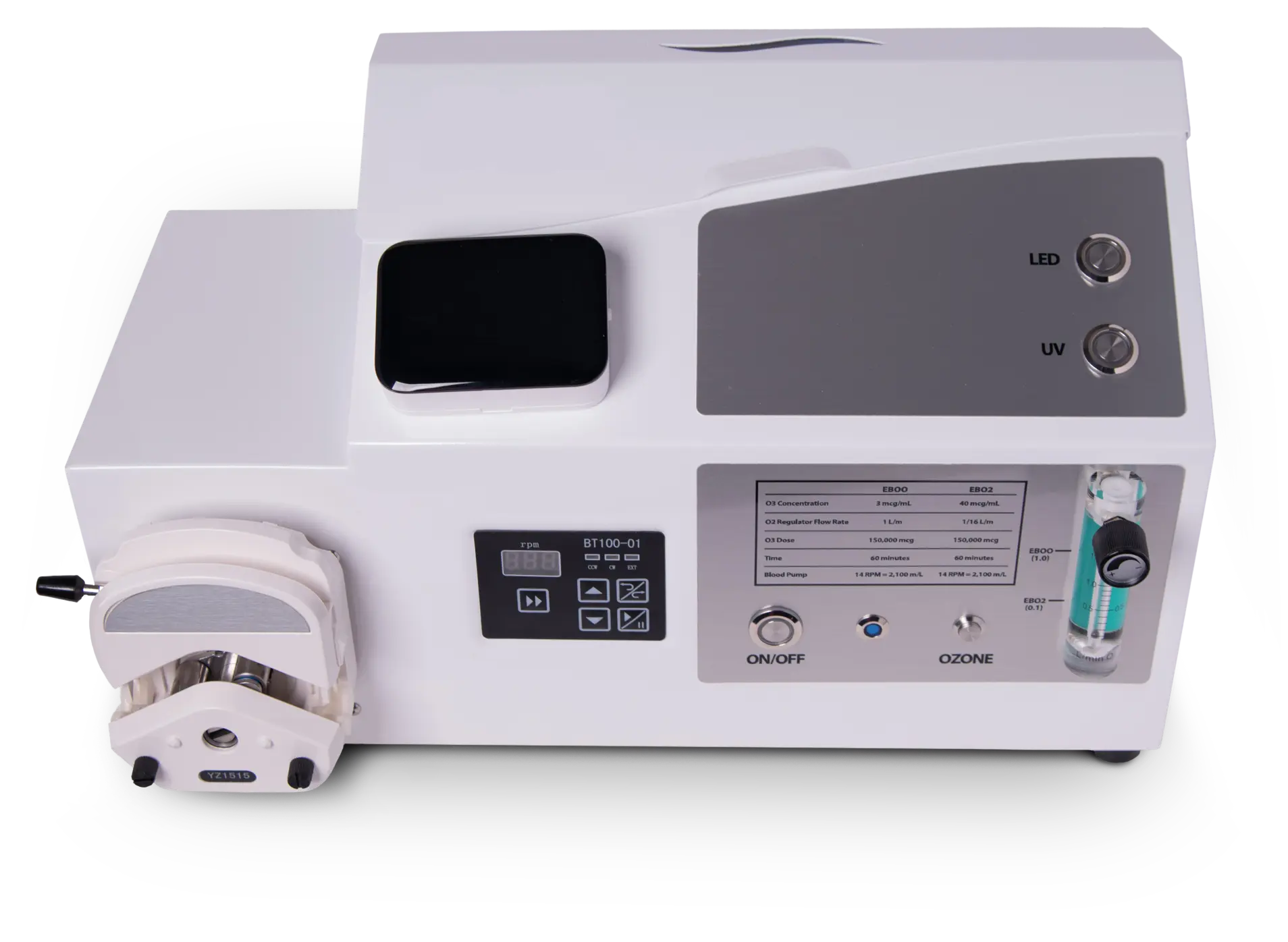


EBOO (extracorporeal blood oxygenation and ozonation) does two things to your blood in a single session. It exposes it to medical ozone across the large surface of a hollow-fibre membrane, and it passes it through ultraviolet light. Each step has a defined physical or biochemical effect. This article explains those effects in detail, and then sets out why we think EBOO behaves differently from 10-Pass ozone even though the total ozone dose is about the same.
If you are looking for what a session involves, how to prepare and how to book, see our EBOO therapy page.
What the membrane in an EBOO circuit does, and what it does not
The cartridge at the centre of an EBOO circuit is a dialysis filter: a bundle of thousands of hollow fibres whose walls are a semi-permeable membrane. In kidney dialysis, blood runs through the fibres and dialysis fluid runs around them. EBOO uses the same cartridge the other way round. In place of dialysis fluid, a mixture of oxygen and ozone flows around the fibres, and the membrane becomes the surface where gas meets blood. Its job in EBOO is to infuse gas into the blood, not to filter the blood.
The ozone itself passes through a 0.2-micron sterile filter before it reaches the cartridge. That is the standard pore size for sterilizing a gas, so what arrives at the membrane is clean oxygen and ozone.
What stays in your blood
Dialysis membranes have pores only a few nanometres wide, built to keep blood cells and proteins on the blood side. Red cells, white cells, platelets, albumin, antibodies, clotting proteins and the lipoproteins that carry cholesterol are all too large to cross, so they return to you. That is by design. Albumin and antibodies are things you want to keep.
What collects in the canister
There is no active filtration in EBOO. Nothing is pumped or pulled across the membrane. Some fluid still crosses passively, and about 200 mL collects in the canister over a session. Because of the membrane's pore size, that fluid is mostly water and the small molecules dissolved in it, such as salts, urea and other small metabolic waste products.
The benefit of EBOO does not depend on what ends up in the canister. It comes from what ozone and ultraviolet light do to the blood that returns to you, which the next sections describe.
What ozone does in your blood
Ozone never reaches your tissues, and it does not enter your cells. It reacts completely within seconds of dissolving in plasma. Everything that follows is carried out by the molecules that reaction produces. This sequence was worked out largely by Velio Bocci and colleagues at the University of Siena and is summarized in their review of the mechanisms of ozone therapy.
In the first seconds: ozone reacts with plasma
Ozone reacts with two things in plasma. Part of it is neutralized by the antioxidants already there, mainly uric acid, vitamin C and the sulphur groups on albumin. The rest reacts with the unsaturated fatty acids carried on albumin. That second reaction produces two families of messengers: hydrogen peroxide, which acts within minutes, and lipid oxidation products, which act over hours to days.
Within minutes: hydrogen peroxide signals to blood cells
Hydrogen peroxide is small and uncharged, so it diffuses into the blood cells nearby before the cells' own enzymes break it down. The dose is brief and small, and that is the point. Inside each cell type it acts as a signal.
- White blood cells. In monocytes and lymphocytes, hydrogen peroxide briefly activates NF-kB, a switch that controls immune genes. In laboratory studies of ozonated human blood this leads to a small, controlled release of signalling proteins, including interferon-gamma, interleukin-2, interleukin-8 and TNF-alpha. When the treated blood is returned, those cells circulate and pass the signal on. The effect is a mild priming of immune surveillance, not an inflammatory surge.
- Red blood cells. Hydrogen peroxide speeds up glucose metabolism in red cells. This raises ATP and 2,3-DPG, a molecule that makes haemoglobin release oxygen more readily to tissues.
- Platelets. Platelets exposed to ozonated plasma release growth factors involved in tissue repair.
Over hours to days: lipid oxidation products switch on Nrf2
The second family of messengers lasts much longer. The best studied is 4-hydroxynonenal (4-HNE), which binds to albumin and travels throughout the body after the blood is returned. This is how a treatment applied to blood outside the body reaches cells that were never near the ozone.
Inside cells, a protein called Nrf2 is normally held in check by a partner protein, Keap1. 4-HNE modifies Keap1 so that it releases Nrf2. Nrf2 then moves into the nucleus and switches on the cell's antioxidant response genes, as described in this review of Nrf2 and medical ozone. The enzymes produced include superoxide dismutase, catalase, glutathione peroxidase, heme oxygenase-1 and the enzymes that make glutathione.
Over a course of treatments: antioxidant capacity rises
Each session is a small, controlled oxidative challenge. The response to it is a larger and longer-lasting increase in the body's own antioxidant defences. This is called oxidative preconditioning, and it has been measured in people. In a study of healthy volunteers given three ozone autohemotherapy treatments, Nrf2 rose in circulating immune cells immediately after ozone exposure, and superoxide dismutase and catalase activity had increased by the end of the study.
Nrf2 and NF-kB also restrain each other. As Nrf2 activity builds over repeated sessions, it dampens the NF-kB signalling that drives chronic inflammation. A 2025 review of ozone as an immunomodulator describes the net result as a shift toward lower inflammatory markers and better regulated immune activity. This is why ozone is described as modulating the immune system and not simply stimulating or suppressing it.
What the ultraviolet step adds
Blood also passes through an ultraviolet chamber during EBOO. Ultraviolet blood irradiation was used widely for infections in the 1940s and 1950s, before antibiotics replaced it. Recent reviews conclude that it works mainly by changing the behaviour of immune cells, including lymphocytes, macrophages and dendritic cells, and not by sterilizing the blood. We also offer it on its own as UVBI.
EBOO vs 10-Pass: a similar ozone dose, delivered very differently
10-Pass ozone and EBOO both treat roughly two litres of blood and deliver a similar total amount of ozone. They differ in the concentration of the gas and in how it meets the blood, and we think that difference matters more than is usually recognized.
How each one delivers ozone
In 10-Pass, about 200 mL of blood is drawn into a bottle, mixed under pressure with about 200 mL of oxygen-ozone gas, and returned. This is repeated ten times. At the usual concentration of 70 micrograms per mL, each pass contains a fixed 14 mg of ozone, for 140 mg in total. The gas and blood meet at the surface of the blood in the bottle and in the bubbles formed as they mix.
In EBOO, blood flows continuously in a thin layer across a hollow-fibre membrane with gas flowing on the other side. Our system has two settings: an ozone concentration of 3 micrograms per mL with oxygen flowing at 1 litre per minute, or 40 micrograms per mL with oxygen flowing at one sixteenth of a litre per minute. Both run for 60 minutes and deliver about 150 mg of ozone while roughly 2.1 litres of blood pass through. That is about the same total dose as 10-Pass, at a lower concentration on either setting. A dialysis cartridge packs thousands of fibres, each about 200 microns wide, into a membrane surface that is typically between one and two square metres. No red or white cell is more than a fraction of a millimetre from the membrane, and the gas is replaced with fresh gas continuously.
Our hypothesis: three ways continuous, large-surface delivery changes how ozone acts
What follows is our reasoning from the chemistry and the physics. It has not been tested in a head-to-head trial.
- Concentration is only one of three dials. In a bottle, the ozone is a fixed quantity that is used up as it reacts, so a useful dose needs concentrated gas. At 3 micrograms per mL, 200 mL of gas would carry only 0.6 mg of ozone. In a flow system, fresh gas arrives continuously across a large membrane, so the same 150 mg can be delivered with dilute gas at a high flow or with more concentrated gas at a low flow. On either setting, no portion of blood meets gas as concentrated as in a 10-Pass bottle. An EBOO dose is set by concentration, gas flow and time together.
- Exposure is more even. Ozone reacts within seconds and within a very short distance of where it dissolves. In a bottle, the blood nearest the gas takes most of the reaction and the result depends on how well the two are mixed. In a thin film, every portion of blood receives a similar dose. We would expect a more consistent yield of hydrogen peroxide and lipid oxidation products per mL of blood, and fewer cells exposed to too much.
- The plasma antioxidant buffer is not exhausted. In a bottle, the plasma in 200 mL of blood has to absorb the full 14 mg within minutes, which draws heavily on its uric acid, vitamin C and albumin. In EBOO, each portion of blood takes a small dose for a few seconds, then returns to the body, mixes with about five litres of circulating blood and comes back with its antioxidants restored. That is many small exposures in place of ten large ones, which is the pattern that hormesis favours.
How this could change the outcome
If this reasoning is right, we would expect three differences. The long-lived messengers that activate Nrf2 would enter the circulation steadily over an hour, not in ten pulses, which should produce a more sustained antioxidant signal from a single session. More of the ozone would go to producing messengers and less to overwhelming local antioxidant capacity, which should mean less stress on red blood cells for the same signalling effect. And the treatment should feel gentler, because the gas is less concentrated than in a 10-Pass bottle on either setting.
What this means for patients
The steps described above are established. What a dialysis membrane holds back is not in dispute, and the ozone signalling pathway has been demonstrated in the laboratory and in people receiving ozone autohemotherapy. What has not yet been done is large clinical trials linking EBOO to outcomes in specific diseases. For that reason we offer EBOO as a complementary therapy inside a physician-guided plan, with screening beforehand, and not as a stand-alone treatment for any condition.
To find out whether it is appropriate for you, read more about EBOO therapy at our Toronto and Oakville clinics or book a discovery call.
References
- Sagai M, Bocci V. Mechanisms of action involved in ozone therapy: is healing induced via a mild oxidative stress? Med Gas Res. 2011;1:29. PMC3298518
- Galiè M, Covi V, Tabaracci G, Malatesta M. The role of Nrf2 in the antioxidant cellular response to medical ozone exposure. Int J Mol Sci. 2019;20(16):4009. doi:10.3390/ijms20164009
- Re L, Martínez Sánchez G, Bordicchia M, et al. Is ozone pre-conditioning effect linked to Nrf2/EpRE activation pathway in vivo? A preliminary result. Eur J Pharmacol. 2014;742:158-162. doi:10.1016/j.ejphar.2014.08.029
- Napiórkowska-Baran K, et al. Ozone as an immunomodulator: new therapeutic possibilities in the treatment of immunodeficiencies. A narrative review. Curr Issues Mol Biol. 2025;47(12):1016. doi:10.3390/cimb47121016
- Boretti A, Banik B, Castelletto S. Use of ultraviolet blood irradiation against viral infections. Clin Rev Allergy Immunol. 2021;60:259-270. doi:10.1007/s12016-020-08811-8
- Rowen RJ. Ozone therapy as a primary and sole treatment for acute bacterial infection: case report. Med Gas Res. 2018;8(3):121-124. PMC6178636
This article is for education and is not a substitute for personalized medical advice. EBOO is not covered by OHIP.

